
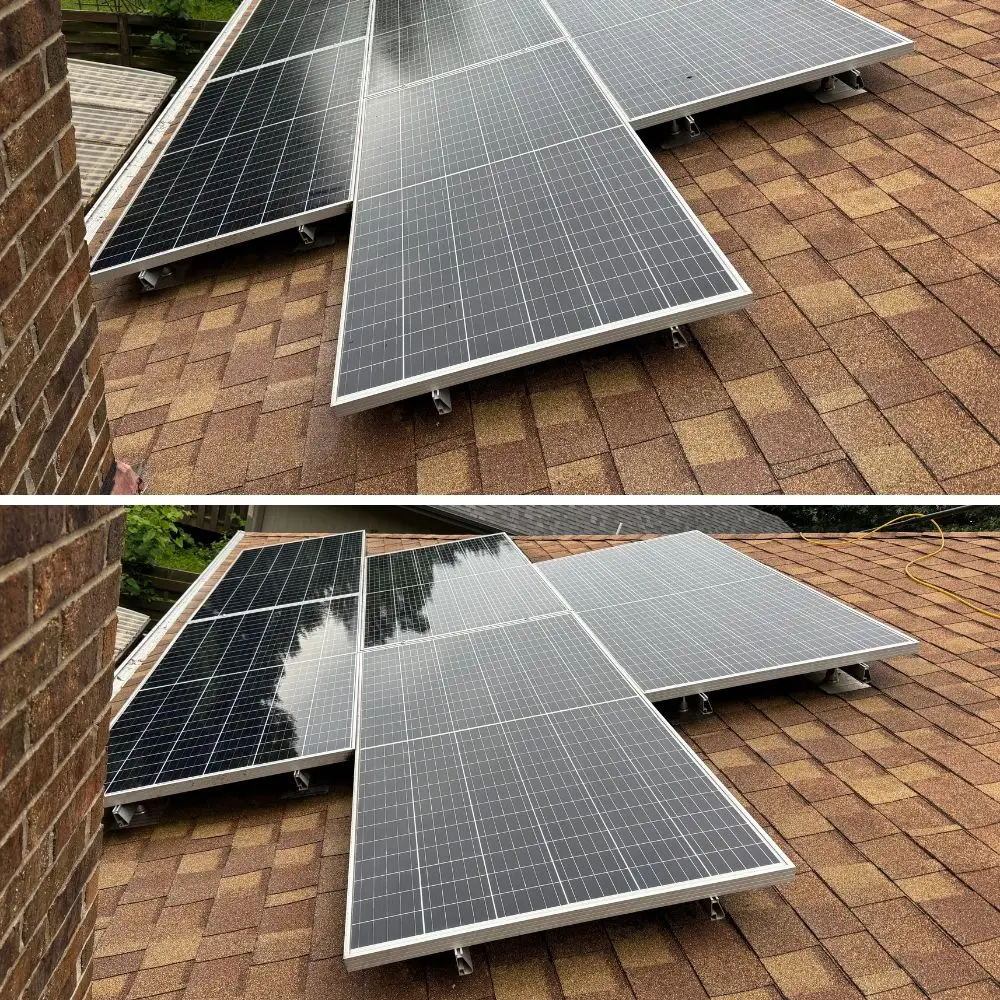
Solar panels across Northwest Arkansas take a beating most homeowners don’t realize is happening. Spring blankets every horizontal surface in oak and pine pollen for weeks. Mature tree cover in Springdale, Rogers, and Tontitown neighborhoods drops leaves and attracts birds directly above rooftop arrays. The water out of most NWA hose bibs is hard enough from local limestone to leave mineral spots on panel glass, which is why hose-water cleaning often costs panels their finish instead of restoring it. None of that triggers a warning on your inverter. It shows up as a slow drop in the daily kilowatt-hours your system was sold to produce.
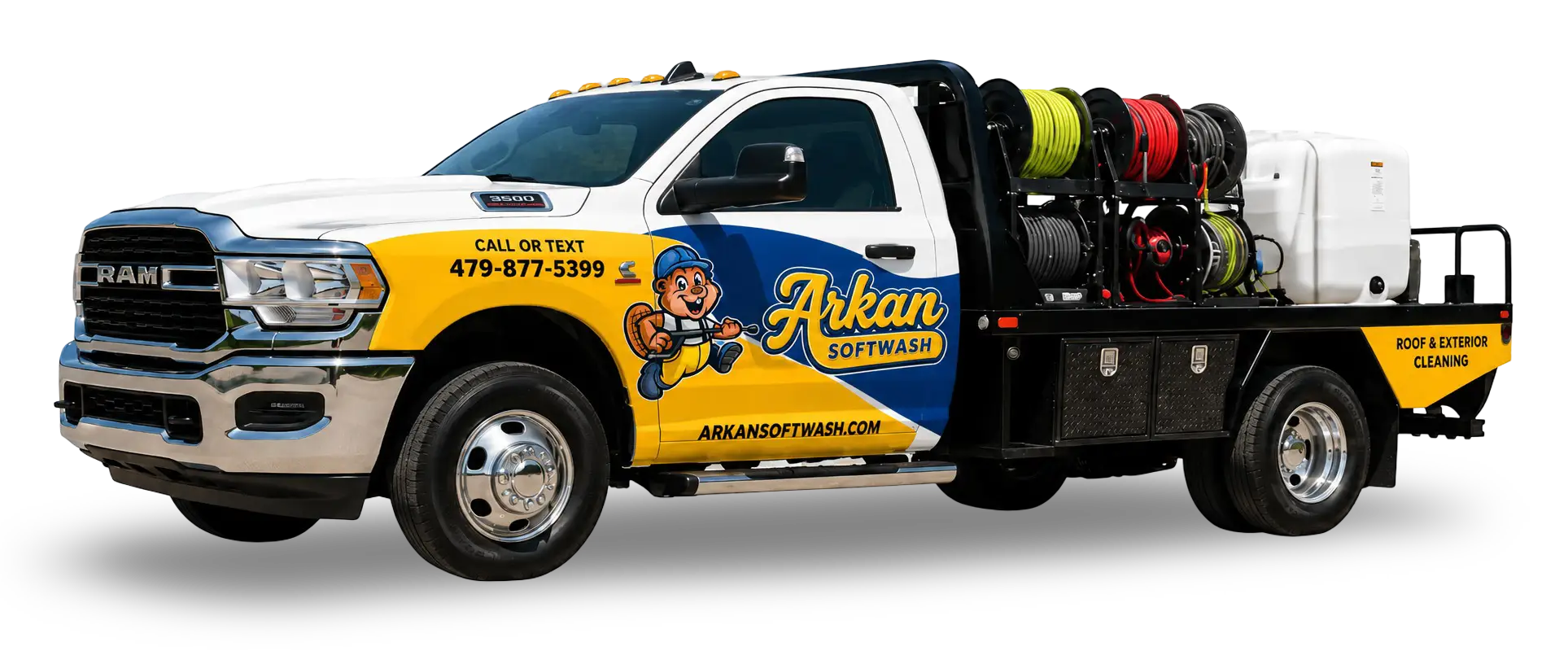
Arkan Softwash is a Springdale-based exterior cleaning company that treats solar panel cleaning as its own technique-driven specialty. On 98% of our solar jobs, the only two things touching your panels are purified water and a brush head built specifically for solar panel glass. We are insured, we carry Plant and Property Protection certification through Spray Wash Academy, and every job is backed by a 100% satisfaction guarantee.
If your panels haven’t been touched since they were installed, or the production numbers on your monitoring app have quietly slid down month over month, call 479-877-5399. Most quotes are handled online from a few photos of the array, so you don’t need to be home for an estimate.

Solar panel cleaning at Arkan Softwash starts at $100 for small, walk-up, ground-mounted arrays where the crew can reach the panels without ladders or harnesses. Most rooftop residential jobs price above the $100 floor because access, height, and panel count all factor into the labor. Solar is priced on its own track, separate from our general pressure-washing minimum, so your quote reflects only the work your specific array actually requires.
Six things move the price on any job:
Most solar jobs land between one and one-and-a-half hours of on-site time. Rooftop arrays at significant height, jobs that call for harness work on a steep roof, and panels with heavy caked-on debris or contractor overspray cross into restoration pricing, and we re-quote those jobs before any escalated work begins.

If you’re already considering a roof wash, house wash, or window cleaning, adding solar to the same visit is the most cost-effective way to get the panels done. The truck, the pure water system, and the water-fed pole are already on site. Our multi-service discount gets better the more services you add to your quote.
We are also running a Spring promotion of $25 off any two services, and solar qualifies whenever it’s bundled with one other service. Call 479-877-5399 when you’re ready, and you’ll get a quote by text and email with a same-day or next-day follow-up.


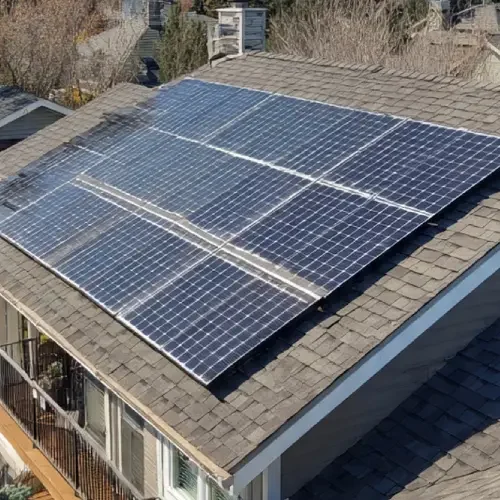
Rooftop systems on asphalt shingle or standing-seam metal are our most common solar job in NWA. When the geometry allows, we clean from the ground with the water-fed pole, which keeps the weight off both your roof and the panels. When the pitch or panel angle is too steep for pole reach, we transition to roof access with a safety harness and ladders secured by levelers and standoffs. The cleaning method is the same either way; access is what moves the price.

Ground-mounted systems are the walk-up scenario. No ladders, no harnesses, no specialty rigging. The crew reaches the panels directly, the cleaning goes faster and safer, and the price drops accordingly. This is the setup that anchors our $100 starting point, and you’ll find these systems on many properties in Tontitown and the outer edges of Springdale.

We clean commercial solar arrays using the same process as residential: inspection, power-down, light pre-rinse, pure water scrub, thorough rinse. Commercial roofs are sometimes easier to access because of flatter pitches, but height on a multi-story building can still factor in. Most commercial arrays are cleaned once or twice per year, the same cadence we recommend for residential.
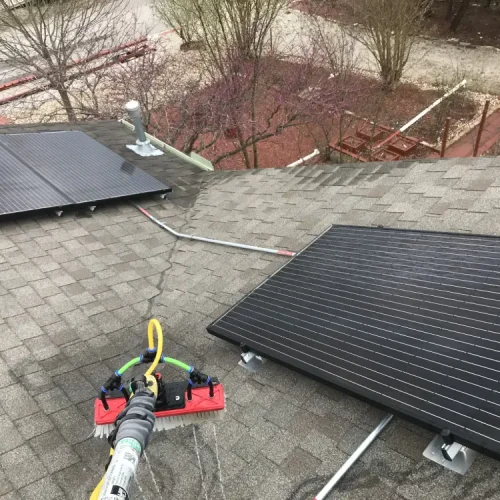
Most jobs are standard: pollen, dust, and routine soiling cleared with purified water and the solar brush. Moderate cleans add a light abrasive pad on the spots where stuck-on bird droppings or thin scale won’t release with the brush alone. Restoration is reserved for heavy caked-on debris, contractor overspray, or years of mineral buildup and may call for Dragon Juice, a biodegradable degreaser we use sparingly. Restoration is priced as its own category, and you’ll see the revised number before any chemistry comes off the truck.

The 98% figure is honest: about two out of every hundred jobs need a light abrasive pad or Dragon Juice for restoration-level buildup, and you’ll know up front when yours is one of them. Most homeowners never see anything stronger than purified water and a brush built for solar glass touch their array, and that restraint is the whole point of how we work.

The water-fed pole lets the crew clean rooftop arrays from the ground without putting weight on the panels or walking the roof. Panels are not designed to be stood on, and most installer warranties say so explicitly. If your installer told you not to walk on them, we follow the same rule.

Most solar cleaning damage isn’t caused by the cleaning itself. It’s caused by a heavy water-filled hose dragged across a panel frame, scratching glass or pulling on the wiring underneath. Our crew positions slack away from the panels and routes hoses so they stay clear of the frames and the underside of the array at all times.

Before any water touches your panels, we ask you to shut down the array and cut power to the system. That step protects the panel electronics during the wet work and prevents accidental breaker trips. You’ll get plain-English instructions, and the crew waits until the array is offline before any cleaning begins.

Before we touch a single panel, the crew inspects the array for damage, exposed wires, and signs of improper installation. If we find any of those, we pause the work, walk you through what we saw, and recommend a call to your installer or an electrician. We’d rather refer you to the right tradesperson than clean a panel that needs a repair.

Our 100% satisfaction guarantee is written into the contract. If you’re not happy with the result, we come back and make it right. If a return visit still doesn’t satisfy you, the job is refunded. To date, we have never had to refund a job.







The job starts the moment you call or email. We ask detailed questions about your array (panel count, mounting, roof type and pitch, panel age, and any specific concerns). The quote comes through by text and email, and once approved, you get a phone call and a text roughly 30 minutes before the crew arrives.
When the crew arrives, they walk the property with you before any equipment comes off the truck. You’ll have a chance to point out specific concerns, ask questions about the scope, and confirm the access plan together. The pre-job inspection follows the walk-through, and the crew flags anything that changes the job before cleaning begins.
You’ll be asked to shut down the panels and cut power to the array. The crew walks you through it on site if you’ve never done it before. The wet work doesn’t begin until the array is fully offline.
If rooftop access is needed, ladders go up with levelers on uneven ground and standoffs that secure them against the home. Roof harnesses come out when the crew has to be on the roof. Hose slack is positioned in a safe area clear of the array.
Before scrubbing begins, the crew does a gentle pre-rinse to saturate and soften whatever is on the panels. That loosens pollen, dust, and surface debris so the brush pass does less mechanical work and there’s no risk of dragging dry grit across the glass.
This is the main cleaning pass. Purified water is fed through the water-fed pole, and the panel-specific brush scrubs each panel from top to bottom so dislodged debris is carried off the glass by gravity. On 98% of jobs, this is the entire cleaning step.
If the brush won’t clear stuck-on bird droppings, hard water spots, or thin scale, the crew uses a light abrasive pad on just those spots. If a panel has heavy caked-on debris or overspray that calls for chemistry, we use Dragon Juice and re-categorize the job as restoration, and you’ll know about the change before any escalated work begins.
The last wet step is a full purified water rinse so loosened soiling doesn’t dry back onto the glass. We do a walk-around with you to confirm the result, you power the array back on, and we send the invoice over once you’re satisfied. For most NWA homes we recommend semi-annual cleaning to stay ahead of spring pollen and summer bird activity, with annual cleaning as the minimum.
Every solar job is backed by the 100% satisfaction guarantee covered above and by the insurance we carry on every service we offer. Three honest details about how that coverage works are worth knowing up front:


On 98% of solar panel cleaning jobs, the only thing touching your panels is purified water and a brush designed specifically for solar panel glass. No chemicals on a routine clean. About 2% of jobs call for a light abrasive pad or Dragon Juice, a biodegradable degreaser, for restoration-level buildup, and you’ll be told up front when that is the case.
Solar panel cleaning at Arkan Softwash starts at $100 for small, walk-up, ground-mounted arrays. Rooftop residential jobs price above the $100 floor based on access, height, panel count, angle, and how soiled the panels are. Every quote is built from those six variables.
Annually at minimum, and semi-annually (twice a year) is what we recommend for most NWA properties. Twice a year lines up naturally with spring pollen season and fall, after summer dust and bird activity have built up. Homes with heavy tree coverage, sprinklers that mist the panels, or recent nearby construction benefit most from the twice-a-year cadence.
You’ll be asked to shut down the panels and cut power to the array before the wet work begins, and the crew walks you through it on site if you’ve never done it before. You’ll also get a 30-minute heads-up call and text before we show up so you can plan around our arrival.
Most solar panel cleaning jobs take between one and one-and-a-half hours of on-site time. Walk-up ground-mounted arrays go faster, and rooftop arrays with harness access or restoration-level soiling take a bit longer.
Yes. Ground-mounted arrays are some of our most common jobs in Tontitown and across rural Springdale where land allows for that kind of setup. Because they are walk-up, they’re also the most cost-effective panels to clean, and they anchor our $100 starting price.
We inspect every array before we start. If we find damaged panels, exposed wires, or signs of improper installation, we’ll show you what we saw and recommend you call a solar installer or electrician first. We’re glad to come back and clean the array once it’s safe to service.
No. We don’t use hose water on solar panels. We clean and rinse with our pure water system, which removes the minerals that cause spotting. We bring our own water, including a 100-gallon onboard tank with the option of a 500 to 1,000 gallon water trailer when a larger job calls for it.
Yes. We offer a multi-service discount that gets better the more services you book on the same estimate, and we are running a Spring promotion of $25 off any two services. Pricing is customized per property, so the easiest way to see what bundling looks like for your home is to call 479-877-5399 for a free estimate.
Yes. We’re insured, and we carry Plant and Property Protection certification through Spray Wash Academy, which specifically covers protecting your landscaping and property during cleaning work. Every job is also backed by our 100% satisfaction guarantee.
Call 479-877-5399 for a free quote on solar panel cleaning anywhere in Springdale, Rogers, Tontitown, or the surrounding NWA area. We’re open Monday through Friday from 8:30 AM to 5:00 PM, and your quote comes back by text and email the same day or the next, often without an in-person visit.