

Get a quick summary of this surface-by-surface guide from your preferred AI assistant.
Most Springdale homes need a full exterior wash once a year. Driveways and sidewalks do best every 6 to 12 months, while roofs typically last about 2 years between cleanings. Springdale’s 47 inches of annual rain and year-round humidity can shorten those timelines, especially on shaded or north-facing surfaces where visible mold and algae growth can appear within 6 months.
If you own a home or commercial property in Springdale, you’ve probably noticed how fast exterior surfaces collect grime. Pollen films in spring. Green streaks in summer. Black stains on the roof by fall. The question isn’t whether your property needs cleaning. It’s how often.
The answer depends on the surface, how much shade and moisture it gets, and what Springdale’s climate does to it between cleanings. We clean hundreds of NWA properties every year, and we’re Plant and Property Protection Certified through Spray Wash Academy. The schedule below is based on what we actually see in the field, not generic national guidelines.
Why Springdale Homes Need Cleaning More Often Than the National Average
The standard advice you’ll find online is to pressure wash your house once a year. That baseline assumes average rainfall and moderate humidity. Springdale has neither.
Springdale’s Climate by the Numbers
Springdale receives about 47 inches of rain per year. The U.S. average is 38 inches. That’s 24% above the national average. Humidity stays between 72% and 77% throughout the year, even in winter. The climate is classified as humid subtropical, and precipitation falls on roughly 100 days per year.
The Pollen-to-Mold Cycle
That moisture feeds a cycle we see on properties across Northwest Arkansas:
- Cedar, oak, hickory, and maple pollen blankets exterior surfaces from February through May.
- Spring rains push mold spores into surface pores.
- Summer humidity sustains the growth.
- By fall, untreated surfaces have visible black or green staining.
According to the University of Arkansas Cooperative Extension, cedar (Juniper) pollen is the most common allergen in NWA, and Arkansas’s winters are too mild to stop mold spore production.
Tree Canopy and Red Clay
Add NWA’s Ozark tree canopy to the equation. Mature cedar, oak, and hickory trees shade entire rooflines, driveways, and fences. That shade blocks the sunlight that would otherwise dry surfaces and slow biological growth.
And the red clay soil common throughout the Ozarks splashes rust-colored stains onto concrete and foundations after every rain.
None of this means your property is falling apart. It just means surfaces here get dirtier faster than in drier or colder parts of the country, and the cleaning schedule needs to reflect that.
How Often to Pressure Wash Every Surface on Your Property
Every surface on your property ages at a different rate and responds to cleaning differently. Vinyl siding and a concrete driveway are not on the same schedule, and they don’t need the same method. The table below gives you the recommended cleaning frequency for Springdale, compared to the national average, along with the correct cleaning method for each surface.
| Surface | Springdale Frequency | National Average | Why Springdale Is Different | Method |
|---|---|---|---|---|
| Vinyl / Metal Siding | Annually (shaded: 6-8 mo) | Every 1-2 years | 72-77% humidity sustains mold year-round | Soft wash |
| Brick / Stucco Siding | Annually (porous: 8-10 mo) | Every 1-3 years | Mold embeds in pores; red clay stains | Soft wash (higher concentration) |
| Hardie Board Siding | Every 6-12 months | Every 1-2 years | Manufacturer recommends 6-12 mo; NWA humidity on upper end | Soft wash |
| Asphalt Shingle Roof | Every 2 years | Every 2-3 years | Gloeocapsa magma thrives in sustained humidity | Soft wash only |
| Concrete Driveway | Every 6-12 months | Annually | Oil + red clay + mold; shaded pads green in 4-6 mo | Surface cleaner at 2,500 PSI max |
| Concrete Sidewalk / Patio | Annually | Every 1-2 years | Lower traffic but same moisture/mold cycle | Surface cleaner at 2,500 PSI max |
| Wood Deck | Every 1-2 years | Every 1-3 years | Humidity accelerates mildew; clean before resealing | Low-pressure chemical wash |
| Composite Deck | Every 2-3 years | Every 2-3 years | More resistant; surface film only | Low-pressure rinse |
| Wood Fence | Annually | Every 1-2 years | Ground-level moisture + shade = fast algae | Low-pressure chemical wash |
| Vinyl Fence | Every 2-3 years | Every 2-3 years | Nonporous but collects pollen/oxidation film | Soft wash |
| Windows | Twice/year (spring + fall) | 1-2 times/year | Heavy pollen season + summer storms | Water-fed pole + purified water |
| Gutters (interior) | Annually (with guards: 5 yr) | Annually | NWA tree canopy drops heavy debris | Hand cleaning |
| Gutters (exterior) | With house wash | With house wash | Included free with every house wash | Soft wash |
The sections below explain the reasoning behind each line.
House Siding: Vinyl and Metal
Once per year. North-facing or heavily shaded walls may need a second wash 6 to 8 months after the first.
Vinyl and metal are nonporous, so mold and algae sit on the surface rather than embedding into the material. But Springdale’s humidity keeps that surface film damp enough for colonies to establish fast. The north side of a home, which rarely gets direct sunlight, tends to show growth first.
What speeds up the schedule:
- Homes under mature tree canopy
- Homes near active construction sites (dust)
- Lots with irrigation sprinklers hitting the siding
- Homes along busy roads like Hwy 71B or Hwy 412 (road film)
Homes with full-sun exposure and no nearby trees can often stretch to the full 12-month mark without visible buildup.
We soft wash all vinyl and metal siding using sodium hypochlorite with an apple-fragrance surfactant. Gutter and soffit brightening is included free with every house wash. Pricing runs $0.10 to $0.25 per square foot depending on siding type, height, dirt level, and access.
House Siding: Brick, Stucco, and Hardie Board
Once per year for brick and stucco. Every 6 to 12 months for Hardie board (fiber cement).
Brick and stucco are porous. Mold spores don’t just sit on top of these materials. They grow into the surface. In Springdale’s humidity, embedded mold can progress from surface staining to permanent discoloration if left more than 12 to 14 months. Once that happens, the surface may need repainting or restoration rather than just a wash.
Hardie board is more durable, but its painted coating still collects film. The manufacturer recommends cleaning every 6 to 12 months. In NWA’s climate, the shorter end of that range is usually the right call.
What accelerates the timeline:
- Mortar joints that trap moisture
- Foundation-level brick splashed by red clay runoff
- Stucco in shaded areas
- Mulch beds against the foundation (holds moisture against the wall)
We use a higher concentration of cleaning solution on porous surfaces to kill mold at the spore level inside the pores, not just on the surface. Still a soft wash, never high pressure. Pressure over 500 PSI damages stucco and strips paint.
Roof: Asphalt Shingle
Every 2 years. Heavily shaded roofs or roofs under overhanging branches may need treatment at 18 months.
The black streaks on asphalt shingle roofs aren’t dirt. They’re Gloeocapsa magma, a type of algae that feeds on the limestone filler in shingles. It’s cosmetic at first, but over time it degrades the shingle surface.
NWA’s humidity keeps spores active year-round. An untreated roof in Springdale typically shows visible streaking within 18 to 24 months. A properly applied soft wash treatment kills the algae at the root, and the results hold for roughly two years in this climate.
Never pressure wash an asphalt shingle roof. High pressure strips the protective granules and can void the manufacturer’s warranty. This is always a soft wash job.
What speeds up streaking:
- North-facing roof slopes (stay damp longer)
- Overhanging tree branches (drip sap and debris)
- Older shingles with worn granules
We check the manufacturer’s recommended cleaning method before touching any roof. Our roof cleaning starts at $199 and carries a 2-year guarantee. If mold or algae regrows within 24 months, we re-treat it free.
Concrete: Driveways, Sidewalks, and Patios
Every 6 to 12 months for driveways with regular vehicle traffic. Annually for sidewalks and patios.
Concrete is porous and absorbs stains over time. In NWA, the combination of oil drips from vehicles, red clay runoff after rain, and mold growth on shaded sections creates a triple threat. A driveway that sits under heavy tree shade in Springdale can go from clean to visibly green in 4 to 6 months.
What accelerates the schedule:
- Oil-dripping vehicles
- Shaded driveways
- Proximity to red clay soil
- Heavy foot traffic on front walkways
Sealed concrete holds up significantly longer. After cleaning, sealing a driveway can extend the time to the next wash from 6-12 months to 18-24 months.
We use a surface cleaner at 2,500 PSI max. Never a wand, which leaves visible lines blasted into the concrete. Pre- and post-treatments even out the finish. Gold Assassin handles oil stains. Concrete cleaning starts at $100, and concrete sealing is available as an add-on.
Decks: Wood and Composite
Every 1 to 2 years for wood decks. Every 2 to 3 years for composite.
NWA’s humidity accelerates mildew growth on wood, especially on shaded decks that don’t dry quickly after rain. Wood decks that go more than 2 years without cleaning in this climate often develop deep-set mildew that requires more aggressive treatment and risks damaging the wood grain.
Always clean a wood deck before resealing or restaining. A freshly cleaned surface holds stain more evenly and the finish lasts significantly longer.
The bigger risk to wood isn’t washing too often. It’s washing with too much pressure. The key is using the right chemicals at low PSI, not blasting the surface.
Decks that need more frequent attention:
- Shaded decks
- Decks near trees
- Decks without sealant
- Decks built over soil rather than gravel
We use sodium metasilicate for cleaning, followed by oxalic acid to brighten and neutralize. No high pressure on wood. Our deck cleaning process is designed to clean thoroughly without damaging the surface.
Fences: Wood, Vinyl, and Metal
Annually for wood fences. Every 2 to 3 years for vinyl. As needed for metal.
Wood fences sit at ground level where moisture and shade converge. In NWA, a wood fence in a shaded backyard can develop visible green algae within 6 to 8 months.
Fences that need cleaning sooner:
- Fence lines along tree rows
- Fences next to garden beds with mulch
- Privacy fences with no air gap at the bottom
Vinyl fences are nonporous but collect surface film (pollen, road dust, oxidation) that makes them look gray or green over time. Metal fences primarily need attention for rust, not mold.
We use the same chemical process on fences as we do on decks: sodium metasilicate followed by oxalic acid, with pressure adjusted based on wood type and age.
Windows
Twice per year (spring and fall) for best results. Once per year at minimum.
NWA’s pollen season coats glass in a yellow-green film from February through May. Summer storms splash dirt and organic debris onto lower windows. Homes on well water are especially prone to hard water spotting after any exterior cleaning.
Windows should be cleaned after or at the same time as a house wash. Chemical overspray during a house wash can spot glass if windows aren’t rinsed properly. Bundling house washing and window cleaning in the same visit avoids this problem.
We use a water-fed pole with six-stage purified water. No streaks, no residue. Window cleaning starts at $100 and includes a three-day rain spot guarantee.
Gutters
Annually for interior gutter cleaning. Exterior brightening included free with every house wash.
NWA’s mature tree cover means gutters fill with leaves, seeds, and debris quickly, especially in fall and after spring storms. Clogged gutters cause overflow that stains the siding below the gutter line and can damage the foundation over time.
Homes under pine, oak, or sweetgum trees and homes without gutter guards need interior cleaning every year. With gutter guards installed, interior cleaning drops to roughly every 5 years.
We offer both gutter cleaning and gutter guard installation. Gutter guards are one of the most effective ways to reduce long-term maintenance on a Springdale home.
The 5 Factors That Change Your Cleaning Schedule

The frequency table above covers the typical Springdale property. Your specific home may need more or less depending on five factors.
1. Shade and Sun Exposure
North-facing surfaces and areas under tree canopy stay damp longer, creating ideal conditions for mold and algae. A north-facing wall can need cleaning twice as often as a south-facing wall on the same house. Full-sun surfaces dry faster and resist growth longer.
Many older Springdale neighborhoods have mature oak and hickory canopy that shades entire rooflines and driveways. Newer developments near the Walmart corridor tend to have younger, smaller trees and more sun exposure. Where your home sits on that spectrum directly affects your schedule.
2. Tree Type and Proximity
Not all trees are equal:
- Cedar and pine drop sap and needles
- Oak drops pollen and tannin-heavy leaves that stain concrete
- Sweetgum drops seed pods that clog gutters
- Cottonwood releases cotton that catches in screens and siding seams
Homes near cedar stands deal with the heaviest pollen loads in NWA and may need a post-pollen wash even if they cleaned the previous fall.
3. Traffic and Usage
Driveways with daily vehicle parking collect oil, tire marks, and road grime faster. Decks used for regular entertaining need cleaning more often. Front walkways with constant foot traffic may need attention before a side patio that sees minimal use.
Homes near Hwy 71B or Hwy 412 collect more road film on siding. Commercial properties along these corridors need more frequent facade cleaning.
4. Soil and Drainage
Red clay soil is common in the Ozarks and leaves rust-colored stains on foundations and lower siding that a garden hose won’t remove.
Poor drainage that pools water against the house accelerates mold growth at the base. Landscaping that touches the foundation, including mulch beds, holds moisture against the wall. If you have planting beds against your siding, expect the lower 2 to 3 feet to need attention sooner than the rest of the wall.
5. Sealed vs. Unsealed Surfaces
Sealed concrete, sealed pavers, and stained or sealed wood all resist staining significantly longer than their unsealed counterparts. Sealing after cleaning can extend the time between washes by 50% to 100% depending on the surface and sealant type.
We offer both concrete sealing and paver sealing as add-on services after cleaning. If you’re cleaning concrete or pavers anyway, sealing at the same time gives you the longest interval before the next wash.
Signs Your Springdale Home Needs Pressure Washing Now
You don’t need to track an annual calendar if you know what to look for. These are the visual cues that tell you it’s time:
- Green or black streaks on siding. Especially on north-facing or shaded walls. This is mold or algae, not just dirt, and it won’t come off with a garden hose.
- Black streaks running down from the roofline. If you see dark streaks trailing from under your shingles, the roof needs a soft wash. This is algae growth, and it gets worse the longer it sits.
- Concrete that’s darker than when it was poured. Years of embedded dirt, oil, and mold darken concrete progressively. If you can see a clean outline where a planter or car was sitting, the rest needs cleaning.
- Deck or fence boards that feel slippery when wet. That slick film is algae or mildew. It’s a slip hazard and a sign the wood is overdue.
- Yellow-green pollen film still visible after May. NWA’s pollen season runs February through May. If you can still see the film in June, the rain didn’t wash it off. It settled in.
- Grime you can trace with a finger on your siding. If you can draw a visible line through the film on your siding, it’s time.
- Tiger striping on gutters. Dark vertical lines on the face of your gutters from oxidation and runoff. Gutter brightening removes these.
- Oxidation on painted or metal siding. A chalky white residue means the surface coating is breaking down. Cleaning now protects what’s left. Waiting means earlier repainting.
- An HOA notice about exterior appearance. Many NWA master-planned communities have exterior maintenance standards. A cleaning is cheaper than an HOA fine.
What Happens When You Wait Too Long
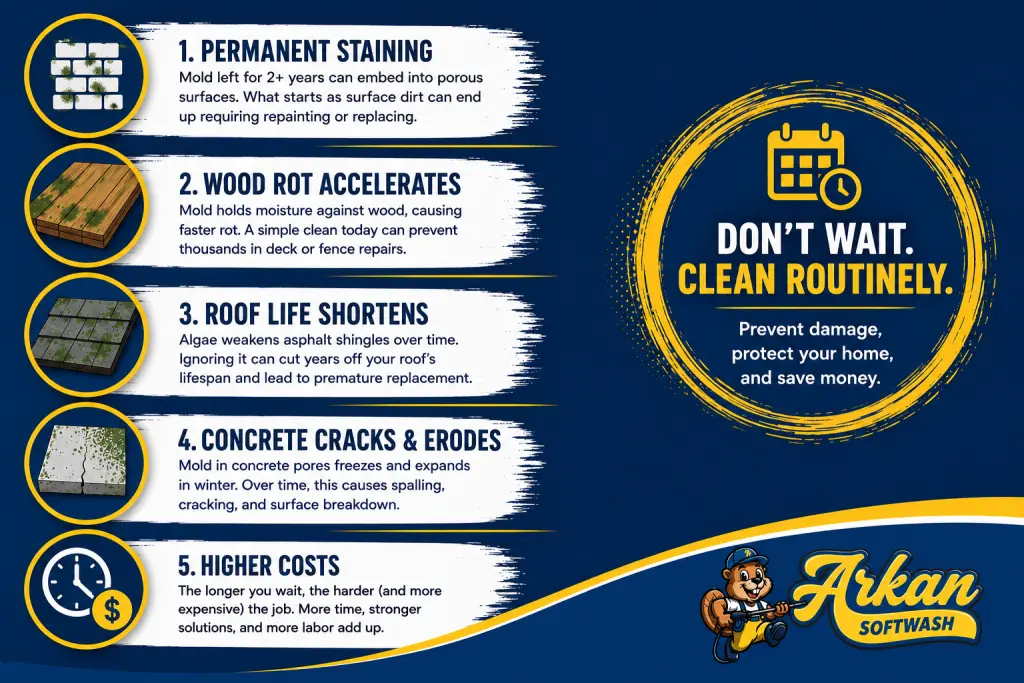
Routine cleaning is straightforward and relatively inexpensive. Deferred cleaning is neither.
- Surface staining becomes permanent. Mold left on porous surfaces like brick, concrete, or wood for 2 or more years can transition from surface contamination to embedded staining that won’t fully wash out. The longer it sits, the more likely you’re looking at repainting, restaining, or replacing rather than just cleaning.
- Wood rot accelerates. Mold and mildew on wood decks and fences hold moisture against the grain, accelerating rot. A deck that could have been cleaned for a few hundred dollars may need board replacement at several thousand.
- Roof shingle lifespan shortens. Algae actively weakens asphalt shingles over time. Left for years, the surface degrades and can lead to premature roof replacement. A roof that should last 25 years may need replacing at 15 to 18 if growth is never addressed.
- Concrete cracks and erodes. Mold growth in concrete pores expands when it freezes in winter. Springdale does get below freezing from December through February. Over time, this freeze-thaw cycle combined with embedded organic material causes spalling and surface breakdown.
- The cleaning job itself gets harder and more expensive. A house washed annually is a straightforward job. A house that hasn’t been washed in 3 to 5 years may need multiple applications, longer dwell times, stronger chemicals, and manual agitation. All of that takes more time and costs more.
This is what we consistently see on properties that have gone years without cleaning. An annual schedule is the simplest way to avoid every one of these outcomes.
Cleaning Frequency for Commercial Properties in Springdale
Commercial properties follow a different schedule than residential because traffic, visibility, and surface type all change the math.
- Retail storefronts and restaurants: monthly to quarterly for walkways, entrances, and drive-thrus. Storefronts on high-traffic roads need attention monthly.
- Apartment complexes and HOA common areas: quarterly for walkways and breezeways, semi-annual for building exteriors, and quarterly for pool decks and amenity areas.
- Office buildings: semi-annual for exteriors, quarterly for main entrance walkways.
- Gas stations and drive-thrus: monthly. Oil, grease, and constant traffic demand frequent cleaning for both safety and appearance.
- Dumpster pads: monthly to bi-monthly. Grease and organic waste accumulate fast and create odor and pest issues.
- Warehouses and industrial: annually for exteriors, more often for loading docks and customer-facing areas.
One-off commercial cleans cost more per visit than a recurring maintenance contract. We build plans on weekly, monthly, quarterly, or annual cadence depending on property type and traffic patterns. We use hot water equipment on commercial concrete where oil and grease are present, contain runoff with berms and sludge suckers, and schedule most commercial jobs after-hours or overnight.
We coordinate with property managers on apartment complexes and HOA presidents on neighborhoods so residents know what’s coming. Commercial building washing, HOA exterior cleaning, drive-thru cleaning, and parking lot cleaning are all available as one-time or recurring services.
A Brief Note on Timing and Method
The best window for scheduling in NWA is late May through June, after pollen settles and before summer storms peak. A secondary window opens in September through October. We’ll cover seasonal timing in detail in an upcoming post.
Different surfaces need different methods. Siding and roofs get soft washed with low pressure and detergent. Concrete gets pressure washed with a surface cleaner at controlled PSI. Using the wrong method on the wrong surface causes real damage. The EPA recommends keeping surfaces clean and dry as the primary defense against mold. We’ll break down the full soft wash vs. pressure wash comparison in a dedicated post. For now, the frequency table above includes the correct method for every surface.
Frequently Asked Questions
How much does pressure washing cost in Springdale, AR?
Residential house washing runs $0.10 to $0.25 per square foot. Concrete cleaning starts at $100, roof cleaning at $199, and window cleaning at $100. Bundling two or more services in the same visit usually qualifies for a multi-service discount. Call (479) 877-5399 for a free estimate.
Can you pressure wash in winter in Arkansas?
Soft washing siding and roofs is still possible on milder winter days above 40 degrees. We avoid concrete and paver work when temperatures drop below 40 because water can freeze in surface pores and cause cracking. Most NWA homeowners schedule their primary cleaning for late spring and a secondary cleaning in early fall.
How do I protect my plants during pressure washing?
We pre-rinse all landscaping before applying any detergent, neutralize plants with Agent Pink bleach neutralizer during the job, and post-rinse everything when we’re done. We’re Plant and Property Protection Certified through Spray Wash Academy. These protection steps happen on every job, not just when asked.
Should I seal my concrete or pavers after cleaning?
Sealing after cleaning is one of the most effective ways to reduce long-term maintenance. It protects against oil stains and UV fading, and most sealed surfaces stay cleaner roughly twice as long as unsealed ones. We offer sealing as an add-on immediately after cleaning, which is the ideal time to apply it since the surface is already prepped.
Do I need to be home during the service?
Not unless interior window cleaning is part of the job. For all exterior work, we call and text 30 minutes before arrival and send before-and-after photos plus a completion report when we’re done. Doors and windows stay shut while we work.
Get a Cleaning Schedule for Your Property
Not sure where your property stands? We’ll look at it and tell you exactly what needs attention now and what can wait. Every property is different, and a quick walk-around is the fastest way to build a schedule that fits your home or building.
Call or text (479) 877-5399 for a free quote. You can also request an estimate online. We answer right away whenever we can, and most standard estimates are returned within 24 hours. Ask about multi-service discounts when you bundle two or more services in the same visit.

